Utterance
Scribe
Intake & transcript — speech becomes citable line.
PC survival sandbox Community-shaped world
A mythic world that keeps only what the record allows — and a game where you help write what comes next.
Below: the world in plain language, then the game itself.
Plainly, before the lore
There is a playable build. It is early, it is single-player, and the community half of the game — the part the rest of this page is about — has not been built yet. Everything below describes what this becomes, not what it is today.
Chopping, mining and hunting. Crafting from recipes. Building and upgrading blocks, and climbing what you build. Hunger, health, day and night, and creatures that come for you after dark. A bow, arrows that differ, tools that wear out and break. Worlds that survive a reload.
No levelling, one biome, no bosses. No accounts, no suggestion board, no voting — and so no submissions are open. The terms that would govern one are written and are still a draft. When that opens, it opens here and it will be obvious.
Start here
If you only read one section, make it this one. The details below add color; this is the shape of the thing.
Long ago, something changed. Survivors call that hinge the Binding. Before it, power could move without leaving a trail; after it, anything that really lasts — a wall that holds, a law that bites, a craft that sticks — owes itself to a line someone was allowed to write.
The Black Ledger is the name people give to that habit reality picked up: sometimes a whispered book of obsidian and soot, sometimes every charter's registers, sometimes just the weight you feel when a thing finally "takes." Wild danger still roams; it just doesn't inherit the world the way it used to.
This is not Earth's history — another age, ink-minded institutions, seal and bell, places where the land still argues with itself. Proper nouns like Tribunal and Contradiction are pieces you'll meet in fragments, not a lecture upfront.
The Black Ledger is a PC survival sandbox in that lineage: a hard land to gather, craft, build, and fight in — where your base, your recipes, and your nerve actually matter.
The twist is who steers what gets built next: the community proposes and votes; the team implements from that signal. No secret roadmap — what earns enough witness gets a serious shot. Only what passes a quality bar becomes part of the build everyone shares.
In the fiction, those arrivals are imagined as new lines in the record — moments when the book opens again and the world reads something new aloud. That's the premise: survival play, plus a public chorus shaping the living canon.
In the world's own language
Everything in World & game, but dressed in the world's own language: the community decides what enters canon next. What passes judgment becomes inscription for everyone; what fails is turned away; what returns is heard again. Updates arrive as Public Readings — the book opening once more.
What lasts must be written
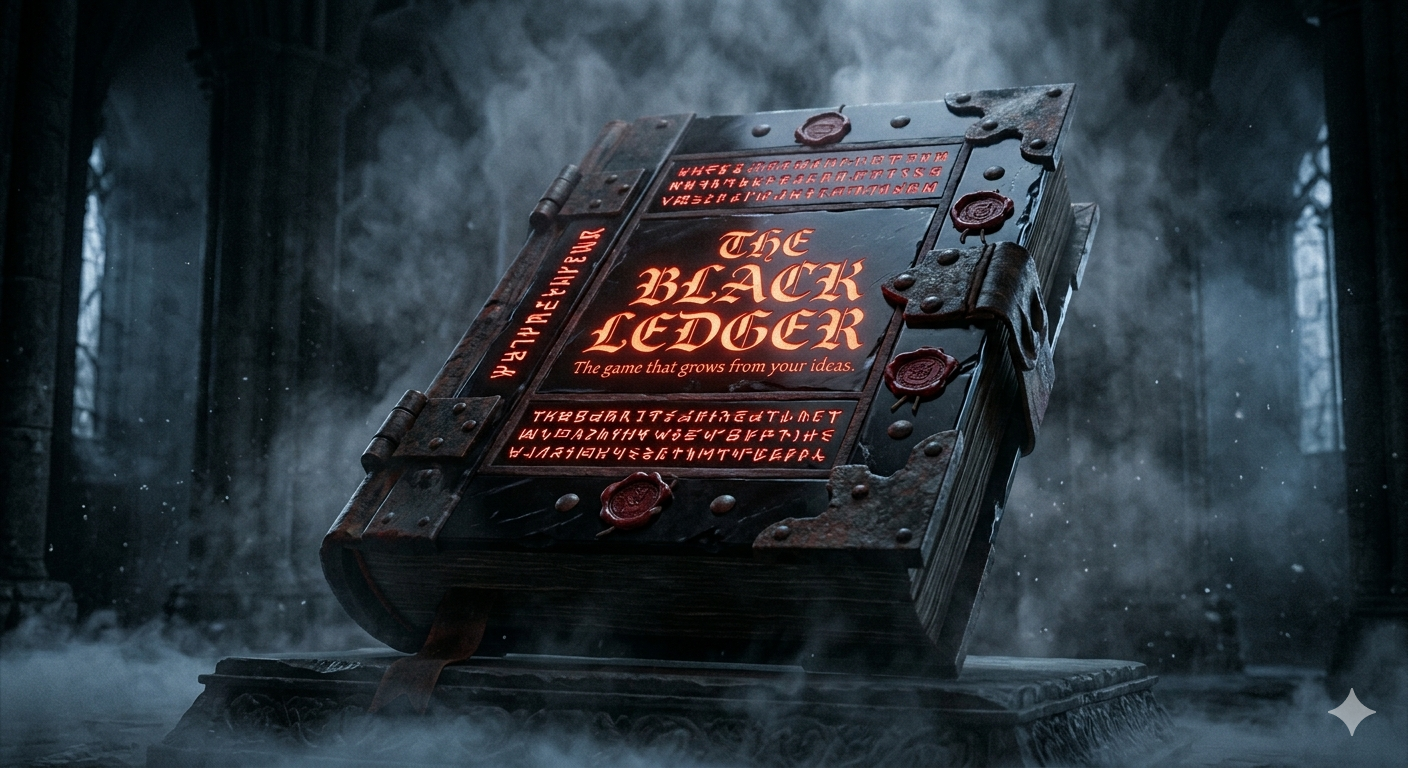
After the Binding, what lasts had to earn a line in the record. Black Ledger names both that law and the actual books that carry it — bound leaves, soot-thick boards, seals you can trace with a thumb. It is not a hypothetical idea you never meet: survivors find, steal, forge, and die over real volumes and scraps. When something new is sealed for everyone, the fiction treats it as fresh ink in the shared register — the world’s living appendix. This is not the history of Earth: another age where ink-minded institutions and survival craft are law made physical.
“Show me the line where this was permitted.”
A voice offers a line; the chorus weighs it; the seal passes or refuses. When new law is read aloud, it is a Public Reading — The world is not finished. The book still opens.
One law, many chambers
Not one throne room — a distributed judgment that turns speech into text, text into trial, trial into seal or break. In the vault you meet officers: ink, blind measure, hammer. In some visions they appear as three heads in a black void, lit only by haze — eyes and moving lips withheld until you are close.
"The Ledger does not pity. It balances."
Scribe
Intake & transcript — speech becomes citable line.
Assessor
Precedent & strain — new claim against old law.
Executor
Seal & enactment — decree made physical.
Where records disagree
Order did not end hunger. When unrecorded power was denied permanence, much of it fell inward — feral phenomena: beasts that are rules without sentences, forests that grow in loops. You survive inside a lawsuit the planet filed against itself. Skeptics blame bad record-keeping; the faithful whisper of unwritten amendments.
Your place in the record
The game is meant to grow by proposal: mechanics, whimsy, balance, lore — offered, argued over, and either sealed or refused. None of that is open yet. There is no board and no vote to cast, and this section describes a promise rather than a feature.
The promise is already written down, and it is unusually specific, because the rules that bind us were settled before anyone could be disappointed by them:
When the book opens
The next Reading is unscheduled, because the first one has not happened. Readings begin when there is something to read — a proposal, a vote, a seal — and that machinery is not built.
Until then there is a prototype to play and a Discord to argue in. Both are early and both say so.